Robotics · 2016
Title: Line Follower and Maze-Solving Robot
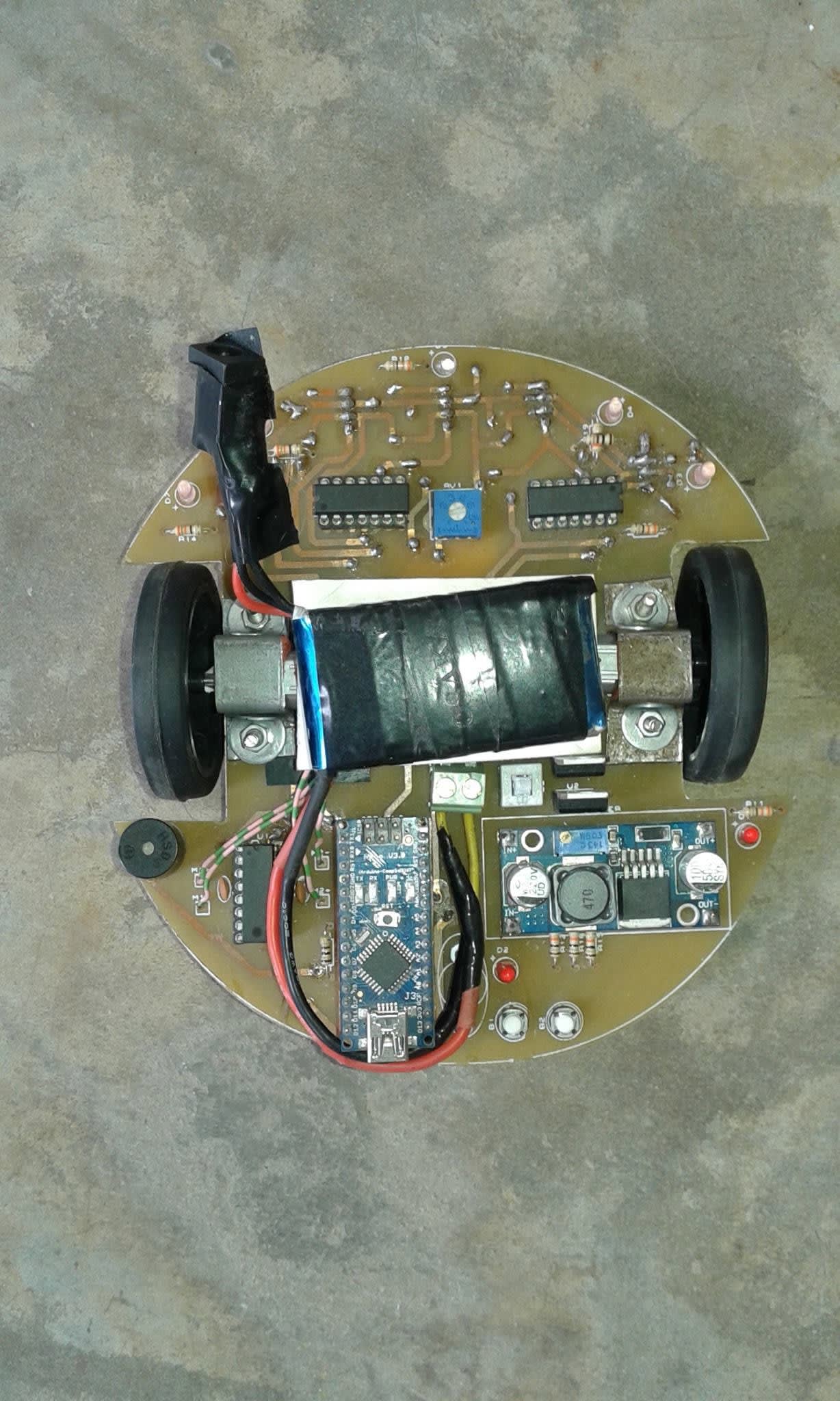
A compact autonomous robot that Team DUET Robo Express designed and built entirely in-house, from circuit design and simulation to a hand-made PCB, soldering, programming and tuning. It won 2nd Runner-up at the Global Robotics Challenge 2016, the IARC Bangladesh Zonal round.
- Autonomous Robots
- Arduino
- PCB Design
- Proteus
- Embedded Systems
- Sensors
Goal:
To build a fast, reliable autonomous robot that could follow a line course and find its way through a maze, designing and building every part of it ourselves, and to compete with it at the Global Robotics Challenge 2016 (IARC Bangladesh Zonal).
What I built:
A two-wheeled differential-drive robot on a custom circular printed circuit board that serves as both the chassis and the electronics platform. An Arduino Nano runs the control program. An infrared sensor array reads the track, and comparator circuits with an adjustable threshold turn the sensor readings into clean signals for the controller. Two micro geared DC motors drive the wheels through a motor driver IC. A lithium polymer battery powers the robot through a DC-DC converter module and onboard voltage regulators, and push buttons, indicator LEDs and a buzzer handle mode selection, calibration and feedback.
We carried out the whole development process ourselves:
1. Designed the complete circuit.
2. Simulated and verified it in Proteus before building any hardware.
3. Designed the PCB layout.
4. Made the PCB in-house: printing the layout, etching the board and drilling it.
5. Mounted and soldered every component by hand.
6. Wrote the control program and tuned the robot for the competition course.
My role:
As Team Leader of DUET Robo Express, I led every stage of the robot's development: the circuit design and Proteus simulation, the PCB layout and fabrication, the component assembly and soldering, and the programming, sensor calibration and tuning of the robot's speed and turning for the event.
Challenges / results:
Making our own PCB meant the layout had to be right first time. Simulating the circuit in Proteus helped us catch design errors before fabrication, saving time and components. On the track, the main challenges were keeping the robot fast without losing the line on sharp turns, making it decide reliably at maze junctions and dead ends, and recalibrating the sensors for the lighting and track surface at the venue. The robot won 2nd Runner-up at the Global Robotics Challenge 2016 (IARC Bangladesh Zonal), organised by ESAB.
What came after:
The same design-to-competition process, from simulation and in-house PCB fabrication to programming and tuning, became the way our team built every robot. DUET Robo Express went on to win national titles at ROBOLUTION 2016 and Cybernauts 2016, and I later taught this hands-on process in the robotics workshops I ran for students.